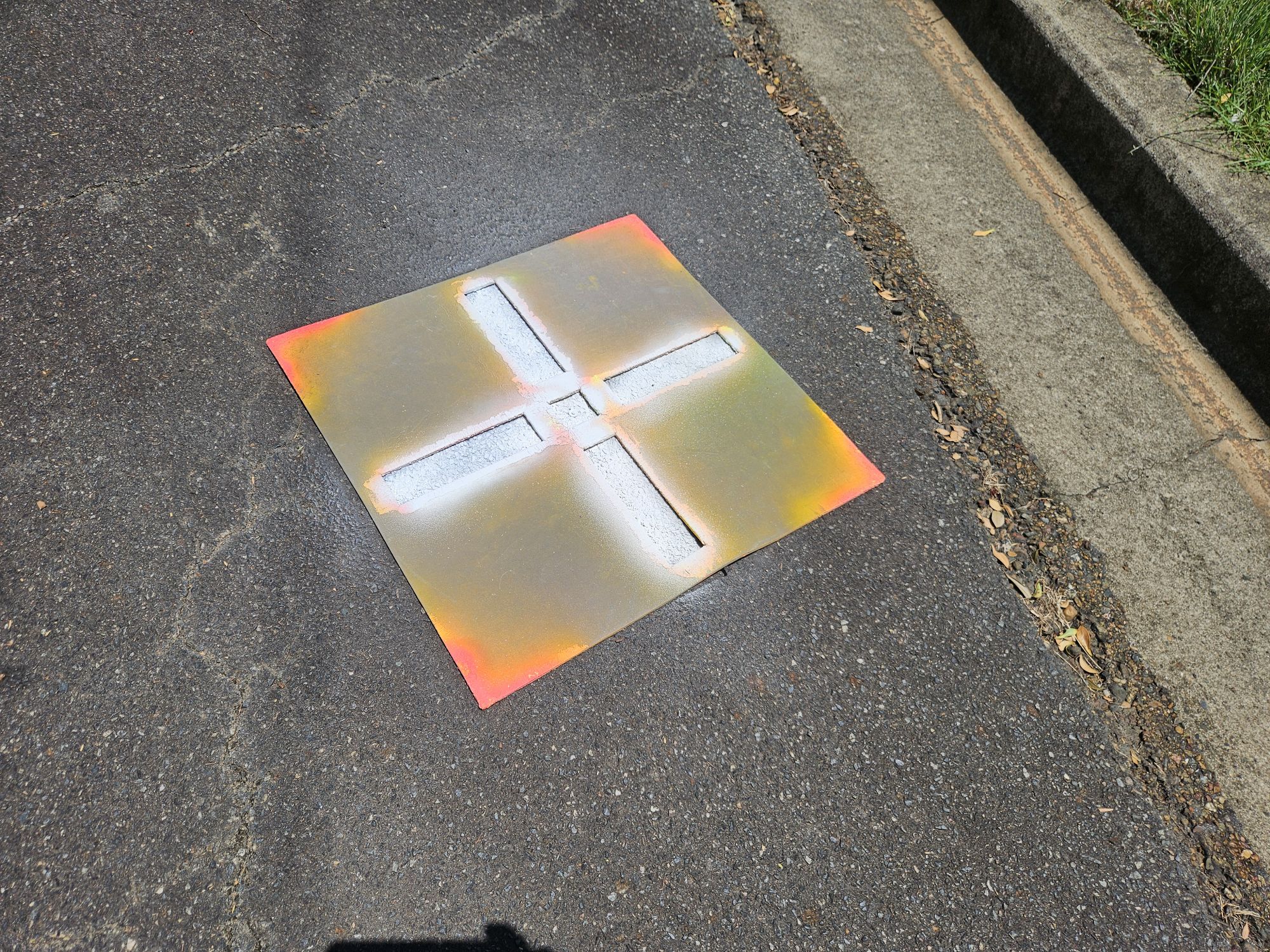
Stencils with a Ground Control Point (GCP) pattern are an easy way to spray paint a reference location directly to a surface and can be created with little effort. They still require an accurate survey pickup after placement to report their location.
The type of ground surface is important when considering using stencils. An unconsolidated surface will perform poorly when attempting to create GCP with stencils.

Concrete pavers or porcelain tiles are an alternative surface that can be placed onto natural ground surface on which stencils would typically not provide the required longevity or visual acuity necessary of a GCP.

If you want to avoid resurveying stencilled GCP, firstly secure a reference pin, which is durable (at the stencil centre). This will provide a reference mark for repositioning the stencil at a later date to repair the painted component when it requires maintenance without the need to fully resurvey the location.


The material from which the stencil is manufactured is important to consider. Rigid stencils work well on hard, flat surfaces; however, on other surfaces, they can result in overspray and paint bleed due to gaps forming between the stencil and surface being painted.
Stencils need to be robust yet flexible for transport. Furthermore, you should be able to remove paint residue, which builds up along stencil edges. Failure to maintain stencil edges results in diffuse margins developing over time.
Paint choice is also important when creating stencil based GCP. Avoid gloss finishes and ensure that the colour contrast is significant between the paint and the material its being sprayed onto.
Lighting conditions can adversely affect the ability to identify reference locations with poor paint choice. Different paints also have different levels of longevity.
Testing the visual acuity of a design is highly worthwhile prior to the implementation of a full GCP network across a site. Flying at planned heights and capturing sample images will demonstrate the effectiveness of a GCP stencil design and the colour suitability.




Leave a Reply