
The best Ground Control Points (GCP) are visually distinct and can’t be confused with other features. Today, GCP are typically identified by contrasting colours to the terrain they are located within. Ideally, they are flat, horizontal, and close to the natural ground surface. Consider them as a two-dimensional object in a three-dimensional world.
The coordinate reference point on a GCP must be unambiguous and definable in image capture at any proposed flight height. Placement position should allow for reference identification from as many directions as possible.
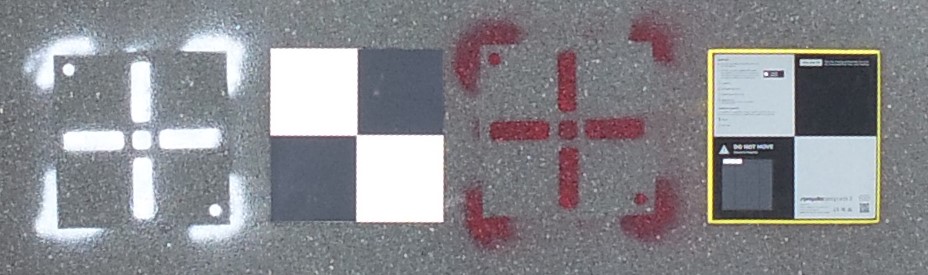
GCP are often designed as an “X” or checker pattern. They can be painted directly on the ground. Alternatively, they can be printed on a durable surface and then affixed to the ground.
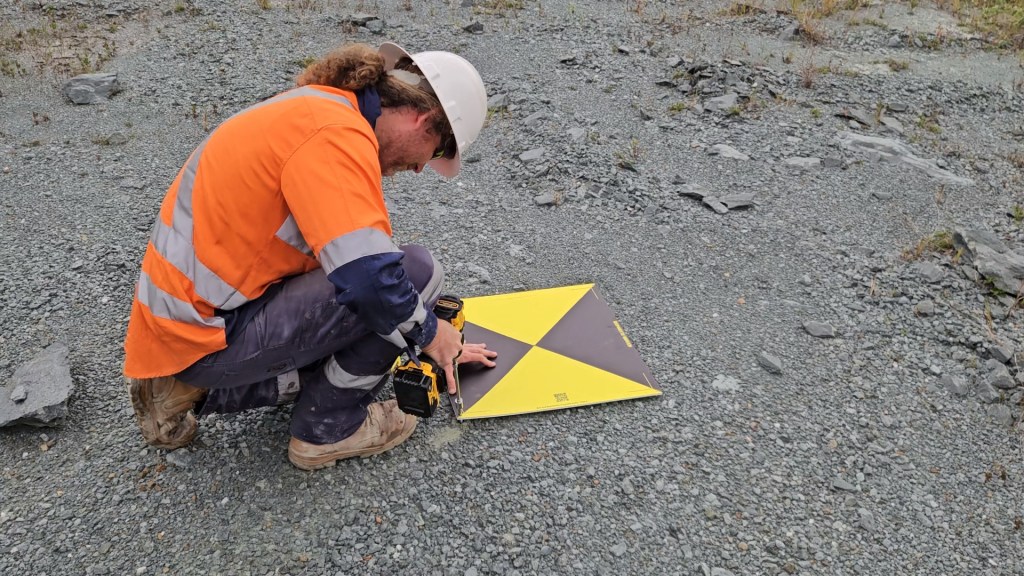
We must repeatedly pick the GCP location reference point in data processing. A valid reference location must be defined on the GCP from multiple images taken during the survey. Choosing the reference as a point rather than an area on the GCP will improve the accuracy of the model.
On unsuitable surfaces first place a manufactured pad on the ground. This provides a base to directly mark the GCP location. The GCP mark can be applied to this, thereby increasing the GCP’s durability. Alternatively, the GCP mark can also be printed onto lightweight and durable materials. You can use a polyethylene board, and then secure it to the ground.
GCP that are 2-dimensional with a reference position close to the ground will give higher precision in image processing. This is better than using features that are elevated and 3-dimensional. Several considerations should be made when deciding what you will use for GCP, like (select topic for more information):
Construction materials
Consider all materials used to construct a GCP when assessing longevity. The surface on which the GCP location is marked be considered durable. Yet, the materials used to mark the location can be less durable. For example, when the location is defined by a painted surface, it will weather due to climatic conditions. It will also experience weathering from debris accumulation and traffic.
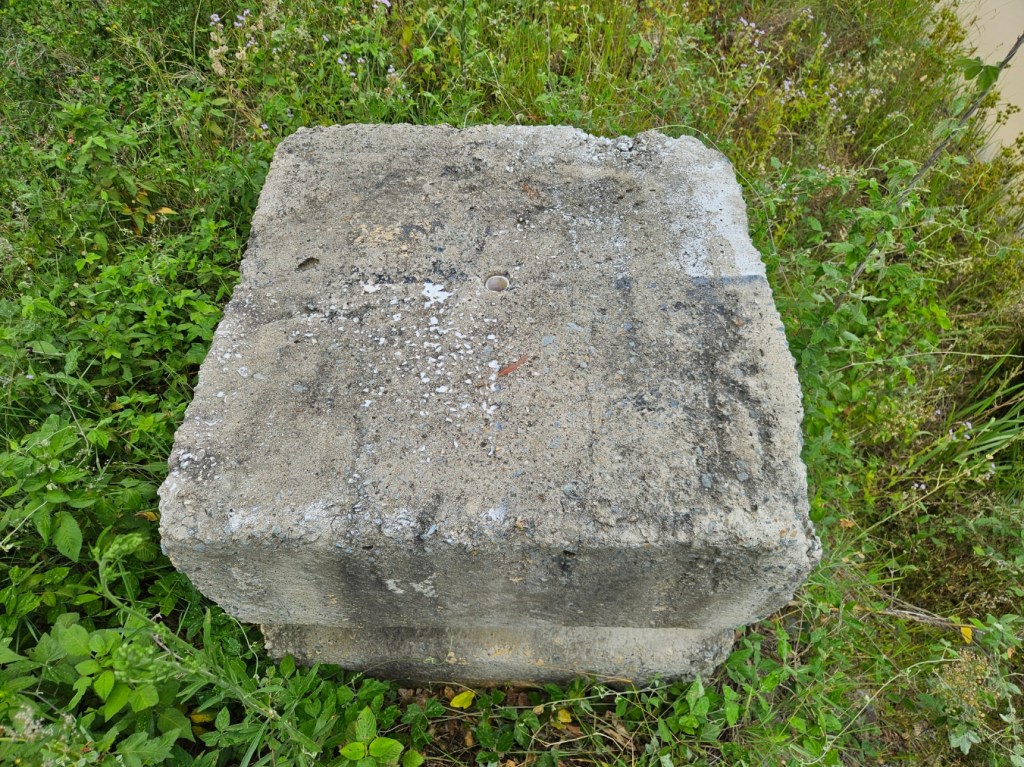
Stencil painted GCP created with aerosol-based paints should be considered temporary on natural surfaces. They should be considered semi-permanent on manufactured pads like concrete or porcelain pavers placed onto the ground. The paint type will have greater durability if its composition is suitable. It will also adhere better to the chosen surface. Enamel-based paints have greater durability than line marking type paint commonly used in surface mark outs. Furthermore, brush painted surfaces typically last longer than spray painted surfaces due to thicker coverage.
Longevity
Think about the longevity required from a GCP site when selecting the type of GCP you use. Note that longevity is in part also related to the maintenance required to enable the GCP to continue to be fit for purpose at the chosen location.
Longevity will be influenced by the manufacturing materials utilised in the GCP’s construction & the environmental conditions the GCP is subjected to. Based on the period over which GCP remain operational they can be considered as either:
- temporary (< 3 months),
- semi-permanent (> 3 months and < 3 years), or
- permanent (+3 years).
In open cut mining and quarrying operations typically, semi-permanent GCP are favoured due to medium term changes that will occur to pit geometry. Temporary points are usually only of value on the active pit and stockpile floors as these areas change quickly. Permanent structures should only be planned outside disturbance areas, however even these may potentially be semi-permanent if frequent maintenance is required to keep the position clear.
Ground Surface
Consider the type of ground surface that the GCP will be placed on. Not any one type of GCP design will be the best for all surfaces. Some designs work very well for one ground surface but perform poorly on others. Others work well on a multitude of ground surface types yet have high costs to either manufacture or construct. Recognise you may require a mix of GCP designs for a site.
The paint adherence capability for stenciled GCP will diminish, and the volume of paint required to mark a GCP will increase on broken ground and soil. Furthermore, on unconsolidated material the GCP position can be blown away, washed off or disturbed easily. On vegetated surfaces such as lawns painted stencil GCP can be cut off or grow out.

Assess if the GCP requires affixing to the ground when placing a pad on the surface. Heavy pads based solely on their weight are less likely to be moved and may not require pinning, Light weight manufactured pads with rigidity can be pressed onto slightly uneven surfaces, however they are more challenging to affix to the ground when the surface is composed of broken rock. It may be necessary to weigh down the corners of the pad to maintain a position if a pin can’t be driven into the ground. Be prepared to have to scrape away cover material or introduce something like crusher dust on the ground to provide a firm and level platform for GCP placement.

Select GCP construction materials which keep the reference position close to the natural ground level. This will maximise precision with GCP definition in later image processing and assist with the accuracy achieved of the surface model generated.
Flight height
The capability to identify the GCP reference position in imagery will be influenced both by the height at which image capture occurs. Image clarity will also be affected by other factors related to the drone and the flight speed.
If we consider image capture with stationary flight conditions, we need to understand what the cameras Ground Sample Distance (GSD) is. GSD refers to the distance on the ground represented by 1 pixel in the image taken by the camera at a specified height.

When you are designing a flight, software will often report the GSD for your UAV type at the planned flight height. Test the ability to clearly assess a GCP design at different flight heights before implementing the GCP in the field and you fly a survey.
The ability to pick a repeatable reference point on a GCP from different images becomes more subjective with higher altitude flights, thereby impacting accuracy.
Typically, the higher you fly the larger the GCP required so that it can be clearly identified.
Camera
The capability to clearly identify the GCP reference position in imagery will be influenced both by the camera taking the image. Clarity of image will also be factored by ISO rating, shutter speed and flight velocity. GSD becomes particularly important with lower end camera payloads
The following table provides GSD for a few commercially available drones popular with open pit surveys. There are calculators also available online for figuring out GSD if you know the specifications for the camera you are using, and the image size being generated. As illustrated some cameras have coarser GSD than others.
| Flight Height (m) | GSD (cm/px) | ||||
| P4 PRO / P4 RTK | Inspire 2 (Zenmuse X5 15mm) | M300 (Zenmuse P1 35 mm) | WingtraOne (Sony RX1R2) | DJI Mavic 3 Enterprise | |
| 30 | 0.82 | 0.75 | 0.38 | 0.39 | 1 |
| 60 | 1.64 | 1.51 | 0.75 | 0.78 | 1.7 |
| 90 | 2.47 | 2.26 | 1.13 | 1.16 | 2.5 |
| 120 | 3.29 | 3.02 | 1.51 | 1.55 | 3.4 |
As a rule of thumb for a 20-megapixel camera (DJI P4) the GCP will need to be approximately 500 x 500 mm in dimensions to be able to select the reference position in imagery captured at a height of 120 m. Consider also that if using an “X” as the design to mark the reference position of a GCP that its line thickness will impact the precision by which the reference location can be later selected. It is for this reason that a pattern is favoured over an “X” as a finite point is defined at the intercept of the four contrasting polygons.
Remember the higher the GSD the lower the accuracy.
Climatic conditions
Environmental conditions should be considered in your GCP design. You should also consider how you can obtain imagery that is neither underexposed nor overexposed.
Consider weather patterns when using stenciled markers. Directly painted ground won’t last very long once you get some heavy rain. Similarly traffic movements over the surface will result in rapid fatigue.
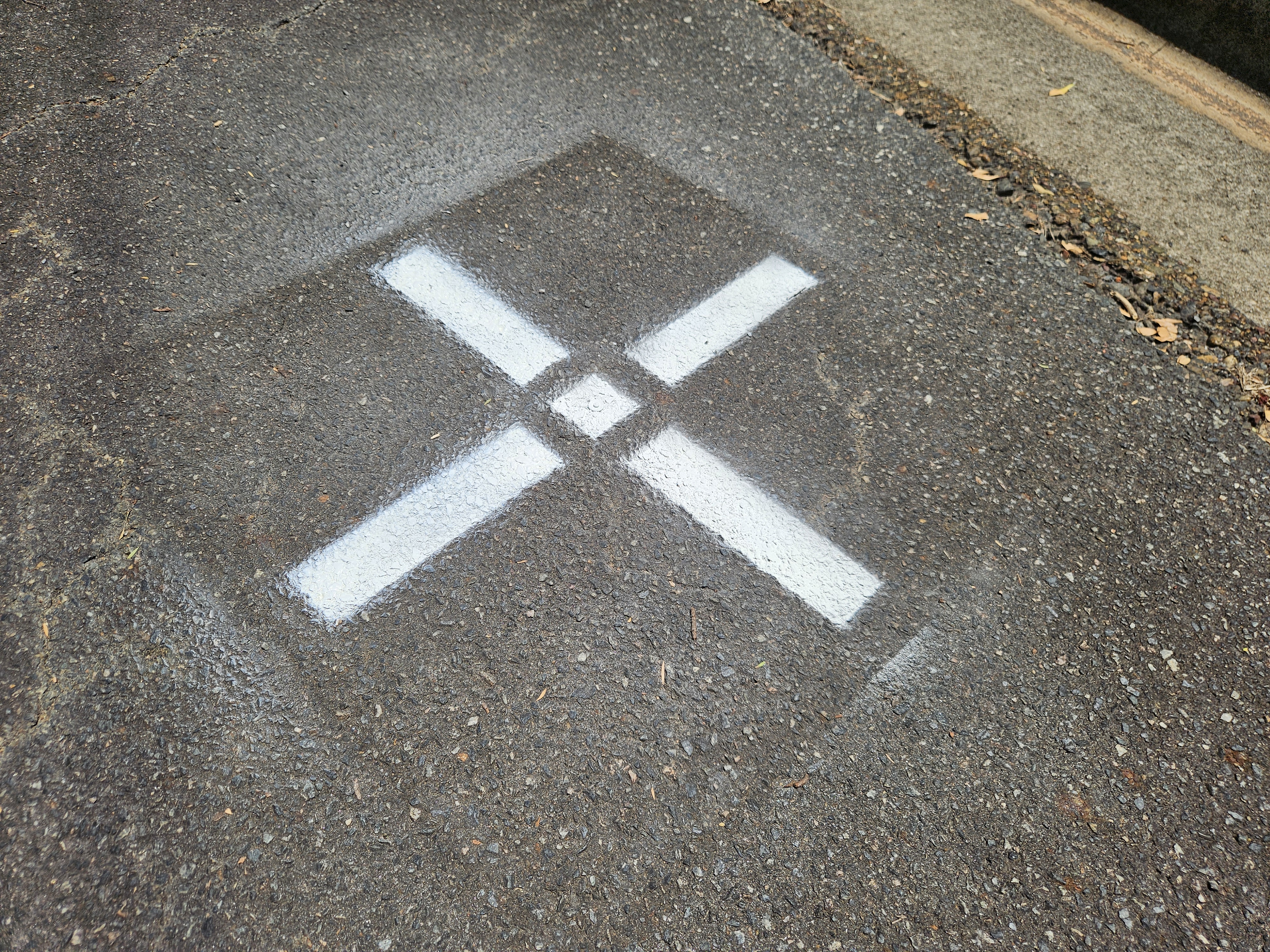
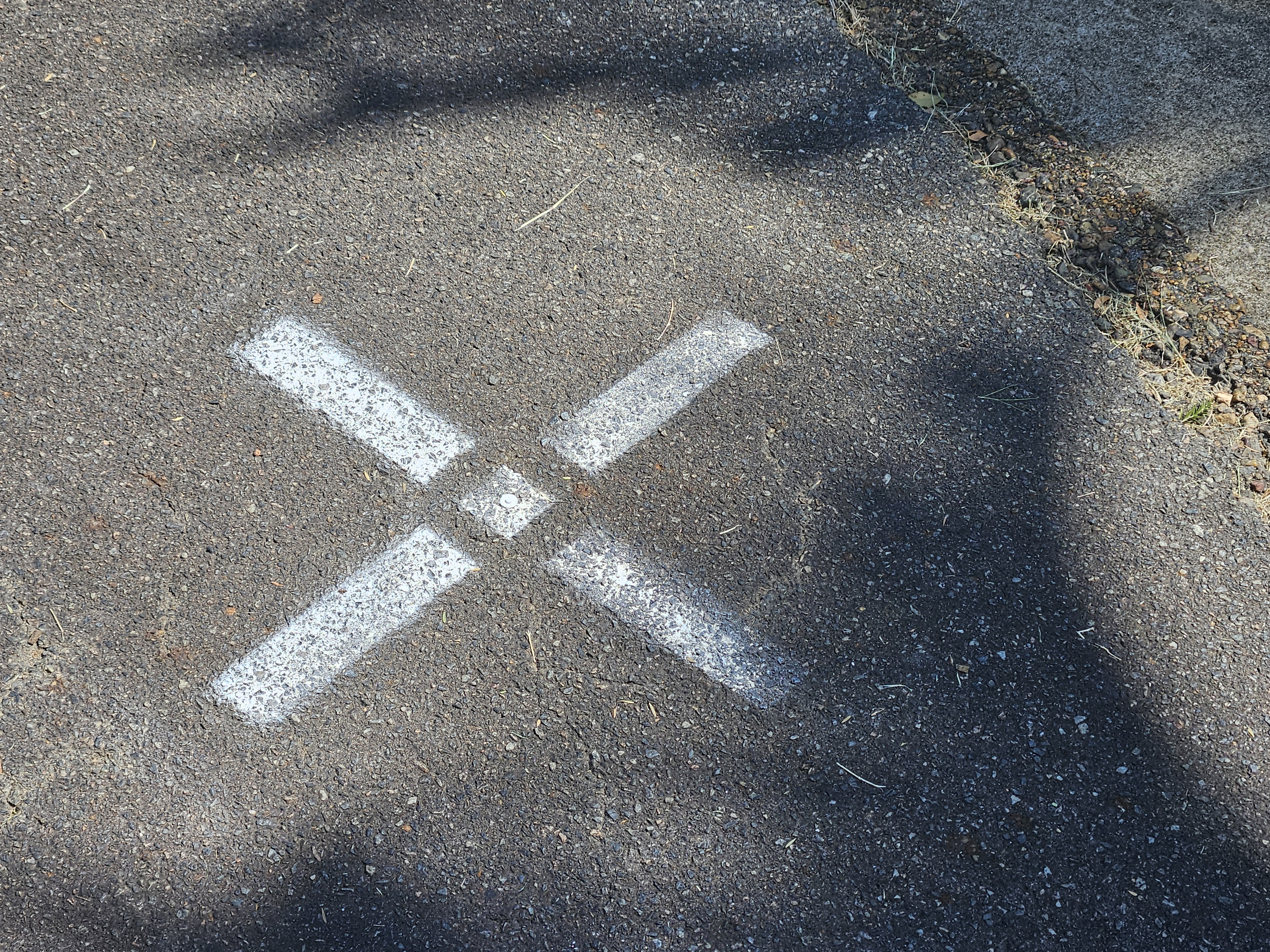
Avoid use of line marking paint if the GCP is likely to get wet or your paint surface is damp. Poor paint adherence can also occur when surfaces are too hot. Extreme temperature fluctuations and high UV also result in premature peeling and flaking of painted surfaces.
Your GCP should have contrasting colours with a matte finish. Bright sunlight reflecting on glossy surfaces will make it difficult to pick the GCP position with accuracy.
Furthermore, lighting conditions can have a marked impact on the achievable accuracy for a survey. Where conditions are cloudy there is less risk of shadows impacting the quality of photos or creating overexposed open areas and underexposed shaded regions (such as around pit walls).
The season and time of day when data capture occurs will impact image quality and as a consequence accuracy. Avoid flying in elevated areas where there is a strong shadow cast caused by low angle lighting, which is typically of sunrise and sunset during the winter months.
Accessibility
Think about access when installing GCP. If an area is going to become inaccessible or hard to access for carrying out necessary maintenance, then ensure longevity of the GCP is your priority.
Also consider the weight of the GCP prior to installation, particularly in areas where you are carrying materials into position. Utilising concrete pads or pavers are generally only of value if you can get them into a site with direct vehicle access.
Both 2-person carry items (concrete paver), or 1 person carry (porcelain tile) with high weights hold inherent risk with trips, slips and strains when carrying over extended distances on broken ground.
Use of light weight yet durable polyethylene manufactured GCP may be more favorable than heavier control pads which require multiple people or machinery to lift into position.
Activities in the area
Surrounding activities can also be of importance in your design choice. The last thing you want to do is install a higher cost GCP with increased longevity characteristics. Then, you find it only lasts a short life. When there is significant change, simply install a temporary GCP. Alternatively, adjust the position to ensure its location stays static longer.


 David Arnott & Assoc.
Leave a comment